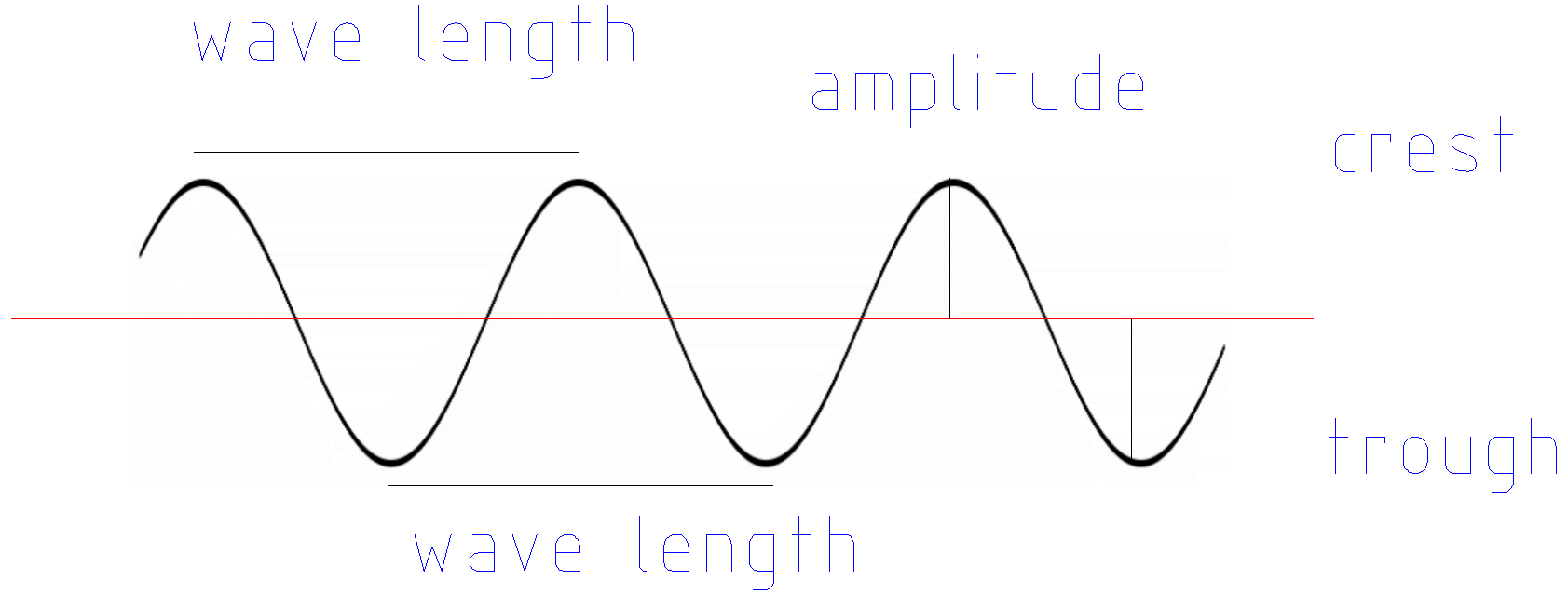
The crest is the point in wave that has maximum distance above the mean position.
Trough is opposite to crest. It is the point that has maximum distance below the mean position.
The maximum distance from the mean position or equilibrium is called amplitude.
Amplitude on a transverse wave is typically measured as the distance between the peak or trough of the wave and the equilibrium position, or the position of the medium at rest.
The distance between two consecutive crest and trough is called wave length.
The number of waves that passes a fixed point in given amount of time is wave frequency.
Wave frequency can be measured by counting the number of crests of waves that pass the fixed point in 1 second. The higher the number, the greater is the frequency of waves. The SI unit of frequency is hertz. If one wave pass in one second then frequency is one Hertz.
Time period of wave is defined as the time to complete one cycle. It means it is time to pass one crest and trough. The standard unit of a wave period is in seconds, and it is inversely proportional to the frequency of a wave, $$ T=\frac{1}{f} $$
The wave is measured in units of angle. 360 degrees, or 2pi radians represents one cycle. The position in the cycle, whether in time or angle, is called it's “phase”, which is like a displacement relative to the beginning of the cycle.